Showing posts with label LA. Show all posts

Tuesday, May 4, 2010

handsom


Photographer Dewey Nicks Santa Barbara Home.

By Mayer Rus

Sometimes it takes a few beats to realize a new day has dawned—and that seemingly radical change may not be so radical after all. When photographer Dewey Nicks and his wife, Stephanie, acquired their heavenly parcel of land on a small oceanfront cul-de-sac in Carpinteria, they intended to build a casual weekend home for surfside sport and repose. As design and construction unfolded, however, certain changed realities in their lives sent the family down a different path to domestic bliss à la plage.

The couple’s twins, Madeleine and George, were starting school. Suddenly, they were on a schedule, and that schedule had to be coordinated with papa’s frequent travels. “There wasn’t going to be a lot of opportunity to use the house. We compared the lifestyle in Santa Barbara with the life we had in Los Angeles, and we decided to make this our full-time home,” Nicks says. “My whole professional life is digital now. I don’t have to be in L.A. to deal with model casting, location scouting and film deliveries from the lab. This move wouldn’t have been possible 10 years ago.”

Stephanie also frames the resolution to step away from the bustling metropolis (still easily accessible) as a lifestyle change. “The kids surf and play in the ocean, and they have the freedom to hop on their bikes whenever they want. This is the perfect neighborhood for their growing-up years. It feels like the 1950s.”

At first glance, the couple’s home feels a bit like the ’50s, too, with crisp, modern lines and echoes of classic midcentury California architecture. But on closer inspection, the house reveals itself as decidedly contemporary in both form and sensibility—very much of its own particular time and place and very much in tune with the exuberant, idiosyncratic spirit of the Nicks clan.

“I was interested in the Sarasota scene and the early houses of Paul Rudolph,” says architect Barbara Bestor on the inspiration for the design. “The vibe is what I’d call humanist hippie. We didn’t want to regurgitate expected modernist tropes.”

In the pages of glossy shelter magazines, one low-slung modernist box tends to look a great deal like the next. But of course, all modernist boxes are not created equal. It is through the articulation of building details and subtle manipulations of scale, plan and proportion that architecture distinguishes itself, and on these counts the home appears distinguished indeed.

“Santa Barbara is the land of restrictions,” Bestor laments. “On this project, we were kept to a building height of 13 feet. We made about 20 study models of simple volumes to determine the best way to maximize the space on a tight lot.”

Indentations break up the main volume of the structure and help establish a fluid, intimate connection between inside and out. Along the facade of the house, the living room pushes out into the front yard, while a picnic table and barbecue niche pushes into the kitchen. Large glass doors that open from the same position at the front and back of the house enhance the bond between indoors and alfresco.

“From the exterior, the house presents a finished, comprehensive image—a modern object in the landscape. The color blocks are part of that,” says Bestor. “The interior is not meant to be so perfect. It has a homey quality that is all about comfort and ease.”

The simple exposed-wood construction of rough-cut fir sets up a warm backdrop for the relaxed drama of the decorating. “We wanted the Paul Fortune experience,” Nicks says, referring to the much admired Los Angeles designer, a longtime family friend. Fortune’s home in Laurel Canyon is widely regarded as a masterpiece of subtle, effortless chic—a rogues’ gallery of international tastemakers and bon vivants swears by its charms.

Fortune brought the same sensibility to bear on this project, gathering choice pieces of furniture and art from Nicks’ collection, filling in where necessary and tying together the assemblage in a cohesive, vibrant living space that reflects the unique character of the family. The decorative scheme includes furniture by Roy McMakin and Warren Platner, vintage Moroccan Art Deco carpets, elegant bits of Danish Modern, paintings by John McLaughlin and Monique Prieto and prints by Ellsworth Kelly in the children’s rooms. Altogether, it’s a handsome, modern mix for a handsome, modern family.

“We call this place the ashram,” says Nicks. “We all get to be a little closer and to simplify our lives. This is who we are right now. It feels good.”

Tuesday, April 20, 2010

Coachella 2010


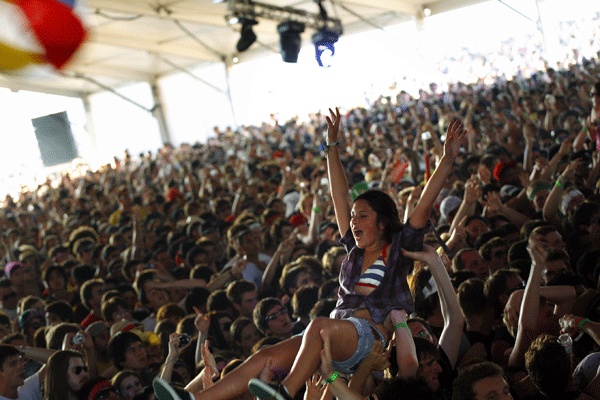
The three-day Coachella Valley Music and Arts Festival came to a close just before midnight Sunday, bringing to an end a weekend that placed rock, dance, hip-hop and electronics on equal footing. It only took closing act the Gorillaz about 10 minutes to tap into each of those genres.

The evolving band-art project -- what originally began as a partnership between Blur's Damon Albarn and comics artist Jamie Hewlett -- was at its most expansive at Coachella. Albarn acted as a composer and a conjurer, directing a mini symphony and waving his arms to inspire flashes of synthesized and electronic sounds. The Gorillaz -- aided by Mick Jones and Paul Simonon, anchors of what was once one of England's most ambitious bands, the Clash -- were, in many ways, the most perfect of Coachella bands.

The weekend played host to superstars such as Jay-Z; pop weirdos including MGMT; and Radiohead frontman Thom Yorke, a legend in the making taking bold experimental leaps as a solo artist. Beyond the headliners, however, were a range of offerings, electronic paranoia (Fever Ray) as well as sweet vintage pop (She & Him) and blues revivalists (the Dead Weather), and that's just scratching the surface.

The Gorillaz view all such styles as ripe for picking, and one would have been hard pressed to find another band on the Coachella bill so eager -- and apt -- at diversifying its sound. "White Flag," off the recently released "Plastic Beach," is an elegant mix of ethnic sounds, hip-hop, modern electronic effects and an occasional symphonic flourish.

Watching it stitched together on the Coachella stage was fascinating. A mini-band using old-world and Middle Eastern instruments was wheeled to the front of the stage, Simonon, with his bass below his waist, stalked out a dub-inspired groove in the corner, and Albarn directed violinists to strike while waving the pennant referenced in the song's title.

LA Times

Friday, April 16, 2010

Pizza Goes Global in LA


It may boast an Italian heritage, but pizza is now claimed by South Americans and South Asians alike, not to mention Croats, Israelis and Armenians.

Brami's Kosher Pizza in Reseda bakes the impossible. Somehow stuffed inside a thin disc ofmalawach — a Yemeni flatbread as dense and flaky as a hundred layers of phyllo — is a pizza. Mozzarella oozes with each bite from between the crisp sheets of dough, bringing with it tangy crumbles of feta, diced tomatoes and briny green olives. At its edge, the crust is pinched into an almost pastry-like braid, sealed just well enough to contain that cheesy filling.

There are traditional kosher pizzas on the menu — rabbinically approved reproductions of the classics — but at Eli and Shelly Brami's restaurant, themalawach pizza is a creation apart. It's as Israeli as it is American, a unique melding of culinary concepts that reflects the cross-cultural pizza boom spreading across Southern California.

Just as certain city blocks contain the cuisines of a half-dozen different countries, pizza in Los Angeles doesn't conform to one nationality — it practically circumnavigates the globe.

There are South American pizzas shaped by decades of Italian immigration and Croatian pizzas forged along the shores of the Mediterranean. Korean and Japanese corporations have taken to testing their unique interpretations of pizza on L.A.'s international appetite. And some foreign pies defy classification altogether, labeled as pizzas by restaurants and diners searching for a simple descriptor. It's all part of the naturalization process.

A purist's definition of pizza might not apply among such diversity. Take for instance Guelaguetza's clayuda, which some refer to as Oaxacan pizza: a parchment-thin tortilla smeared with asiento (rendered pork fat) and black beans and topped with cheese, lettuce and slabs of meat spread across the tortilla like continents cast off into separate hemispheres.

Others consider the lahmajune from 60-plus-year-old A. Partamian Bakery to be Armenian pizza. The flatbread is completely covered with a ruddy, gamey mix of ground lamb, tomatoes, bell pepper and spices and baked until it borders on blackened. Unlike some more brittle versions made elsewhere, lahmajune from the West Adams shop is as pliant as a New York slice.

These are inexact incarnations — pizzas not by birth but by adoption. Still, there's credence in such classifications. At Pasadena's Old Sasoon Bakery, the Georgian breakfast flatbread khachapuri can't help but recall an oblong, egg-topped pizza. The Geragosian family's Armenian-by-way-of-Syria bakery produces a superior version of the canoe-shaped staple, capped with a blend of Middle Eastern cheeses and a cracked egg. Drag a piece of the khachapuri's billowy, bready crust through the egg to release a tidal flow of yolk that flavors every inch of this morning meal.

Pizza-like mankousheh at Forn Al Hara in Anaheim also blurs boundaries. Fresh out of the oven, its crust is charred and blistered with pockets of air as taut as overinflated balloons. When it's cooked with cheese and sujuk, a peppery, cumin-shocked beef sausage freed here from its casing and transformed into a meaty spread, the Levantine flatbread shares more than a passing resemblance to pizza.

Maybe it's just another unpredictable result of globalization, but previously pizza-less countries have developed their own distinct creations. Waves of Italian immigration brought pizza to Argentina, and Mercado Buenos Aires imports that South American style to Van Nuys. Each slice of its Buenos Aires pizza is crowned with a piece of cured ham, a sliver of roasted bell pepper and a single green olive.

Costa Mesa's months-old Il Dolce Pizzeria highlights another pizza of Argentine invention, the fugazzeta. From owner Roberto Bignes' wood-fired oven comes not the typical focaccia-like fugazzeta, but one with a chewy Neapolitan crust, airy at its edges and thin as a pane of glass at its center. The powerfully simple fugazzetais sauce-free, spotted with milky patches of house-made fior di latte cheese and blanketed with julienned sweet onions and a dusting of oregano.

Sometimes it's all about the sauce. So it is at Dean's Pizza in Long Beach, a true fusion that's part Thai restaurant, part pizzeria. Its parallel menus are mostly kept separate, but there is one notable intersection: the Thai curry pizza.

Dean's uses a red curry sauce redolent of kaffir lime and lemongrass that burns with a subtle, creeping heat. Curry pizza here can be constructed virtually to anyone's liking, with a choice of toppings (think pepperoni and pineapple) or without them altogether (the lactose-averse can order the pizza without cheese). Try reconstructing something close to a traditional red curry with a pizza of chicken or tofu and bell peppers.

L.A. has also become a testing ground for foreign pizza chains informed by the strip-mall standard American franchises that have set up shop abroad. But don't expect pedestrian localizations of Pizza Hut. Instead, inspired overseas entrepreneurs have been taking the basics and building them into peculiar pizzas that go beyond the boundaries of convention.

Seoul-born Mr. Pizza Factory's Koreatown branch is the only one of its kind in the U.S. Consider the bulgogi and seafood pizzas first, but ultimately opt for the Potato Gold: potato wedges, bacon, corn, crushed tortilla chips, cheese and a drizzle of sour cream. It recalls a plate of potato skins you might find at a sports-bar happy hour until you reach the layer of sugary sweet potato paste buried deep within the doughy crust. It's a bracing surprise.

Similarly startling is Strawberry Cones, a Japanese chain that recently opened its first U.S. restaurant in San Gabriel. Its early signature might be the teriyaki mochi chicken pizza: a rice-flour crust covered with cubed chicken, red onions, mozzarella and Romano, teriyaki sauce, a squirt of mayonnaise, shards of dried seaweed and mochi, squares of glutinous rice superheated until they can be stretched like cheese.

There's also a line of "ninja pizzas" whose crusts are colored a pronounced gray by powdered chikutan, Japanese bamboo charcoal regarded for its mineral richness. On the salmon and avocado pizza, the chikutan crust tastes a bit like the sea air that swirls above a beach bonfire.

Until recently, you could even find Filipino pizza, multicultural pies topped with fatty pork sisig, Spanish sardines or chicken adobo. But don't take its disappearance as a sign of waning pizza popularity — there are more global offerings on the horizon.

San Pedro's Pavich's Brick Oven Pizzeria is about to open a second location that owner Zdenko Pavic hopes will start cooking by May. It will have not only dedicated seating but also an expanded menu to complement its mammoth Croatian pizza laced with purplish ribbons of Balkan smoked beef.

Also coming soon is Bella Vista, a Brazilian pizza buffet on track to open this month in Culver City's Brazilian Mall. As owner Marcelo Gomez describes it, the restaurant will operate like an all-you-can-eat churrascaria, with waiters bringing dozens of different pizzas straight to the table until you can take no more. Among the Portuguese-style pies and seafood-intensive slices, it might be the dessert pizzas that prove most distinct, concentrating on fruit-focused pairings like banana and cinnamon and guava paste and cheese.

However you slice them, these international interpretations of pizza, each more unexpected than the last, prove that in Los Angeles, the world truly is flat.

April 15, 2010

Tuesday, February 23, 2010

Sunday, November 15, 2009

the gaga gets done.


As the museum banners its 30th-anniversary gala and exhibition (the party on Saturday is being directed by artist Francesco Vezzoli and includes a one-off performance piece he's conceived for pop singer Lady Gaga and dancers from the Bolshoi Ballet), the aim, said Young, is to show "that MOCA has turned itself around, MOCA is out of survival mode, and is self-sustainable and moving forward."

But MOCA still has work to do before many in the art world are convinced it is really back, says Lyn Kienholz, founder of the L.A.-based California/International Arts Foundation, which aims to raise the profile of California artists.